Sunday, October 21, 2007

Interview Responses

Washington D.C.
Mother and Father
Yes both of them
Dad Political Science, Mom French
6
Facebook, sports sites.
Yes
Pretty Positive, mainly because both parents were not computer adept and wanted me to learn and teach them.
My dad being a lawyer, influenced me to still use a library for my research.
About the same, not sure why?


20
Journalism Studies
Denver
Mother and Father
Yes
Father plant biology, Mother Midwifery (Nursing)
5
14
E-mail, Facebook, News, Research, IM
Yes, play less games online on the computer, though still play games online on xbox
My parents always thought I use the internet too much
Their attitude didnt affect me, though mine affected them, now they use the internet all the time.
Their opinion changed because now everyone in my family has their own computer.


Matt Collin
20
Sports. Entertainment and Event Management

Cleveland, OH
Mommy and Daddy
Yes
Medicine
5-6 yrs old
13
Email, Facebook, Fantasy
facebook
Dont overdo it...schoolwork first
limited my use online
im in college...they dont control me anymore!


Rachel Monserrate
25
Mom and Dad
Yes, both
Dad animal science, Mom social studies
6
7th grade, age 13
email, facebook, read news, research
in the last year, I started using facebook. that's about it
My parents don't really understand it. They're computer illiterate, so they just ask me how to use their computer. They don't really address my usage.
They've not influenced my usage, and I haven't seen a change

Thursday, October 18, 2007

Video: A Vision of Students Today

From Michael Wesch, a professor from Kansas State and the creator of The Web is Us/ing Us, this is a video about the modern student. There seems to be a large focus on social networks, in particular Facbook. Check it out:


Tuesday, October 16, 2007

collective intelligence survey on parent-kid tech relations

Please interview 4 people in the 18-26 age range and who used computers as a teens. Please post your interviews here on the blog by Sunday night. Before class next Tuesday read everyone elses interview notes.

Here are the questions we came up with in class. I added a few. Try to get the conversation flowing in your interviews and get all of the information and stories you can out of your interview subjects. (Sometimes the best insights come when interviews veer from the script.)


Name
Age
Major (if in college)

Where did you grow up?
Who did you grow up with (mother, father, grandparents...)?
Did your parents/guardians go to college?
If so what did they study?
How old were you when you were first introducted to a computer (including games).
When did you start using computers on a regular basis?
What do you do online?
Has what you do online changed over time?
What was your parents or guardians' attitude toward your computer use? Please explain.
How did their additude come into effect or influence your ability to do what you want online?
Have their attitudes changed today?
Why or why not?

Thursday, October 11, 2007

My God is Google

Yes, it's true. I and an expansive group of others believe Google to be the true God. She is not supernatural, but certainly is the closest humanity has come to experiencing a divine being. We have developed a nine point proof, asserting Google's position as God, available at our web site: thechurchofgoogle.org.
Please join us, Googlists, in our quest against Satan (Microsoft) and exploring the boundless dimension of human knowledge. :)

Saturday, October 6, 2007

The GoogleMonster


(Image used from alternet.org with permissions provided by educational fair use. alternet.org [presumably] owns all official copyrights)

Alternet.org posted a great article about the possibility of Google suddenly being incredibly evil. Obviously quite interesting in light of our recent discussion topics in class.

A company that is supposedly, green, conscious, and consumer friendly is marketing our data (or at least their ability to mine our data) at an alarming rate to Madison Avenue. They have an entire sales force devoted to selling your information to people who want to market to you.

The "getting-to-know-you" approach by Google, sold as a cute and cuddly approach to getting to know you but subversively acting as a way to steal your information, is a serious threat to our privacy, as the article states.

The article does a good job of pointing out the irony of the oft-touted stance of net neutrality and working for the public good, while at the same time working hard to undermine our privacy.

Thursday, October 4, 2007

How Net Neutrality is like ordering a pizza

While discussing the concept of net neutrality with friends a week or so ago, this amazing analogy came up that really stuck in my mind. Here is the type of scenario that net neutrality laws are trying to prevent on the web:

Imagine if, when you called up your local pizza place to order your favorite pizza, you suddenly got this message: "We're sorry, but as a tier 1 user of the phone company, you will have to wait several minutes before connecting to your local pizza delivery service. However, if you wish to order from Pizza Hut, press 1 now and we will connect you immediately."

Such a scenario coming along after so many years of having an open phone line where you can call any pizza place without discrimination would be intolerable, but it is very similar to the scenario that net neutrality legislation is trying to prevent. The reason why companies like Google are for net neutrality and on the same side as small web companies and individuals who do not want access to the web restricted is because they would have to pay extra money to the ISPs in order to allow users faster access to their site. It's not that they couldn't afford it, but having risen from a small idea to one of the most massive online enterprises as a result of the open internet, they realize that forcing producers of content to pay more money for faster content delivery to users will destroy the ability for start-ups to use the internet to grow.

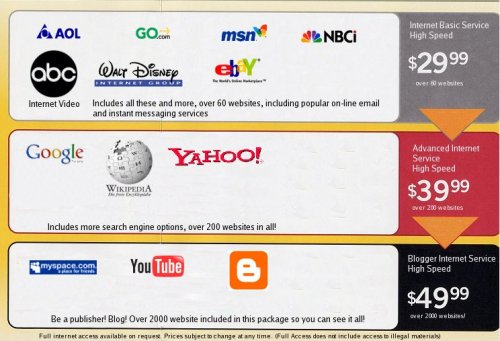
The thing that I find really disturbing about what the ISPs want to do is that they are the middlemen of the internet. Creating a tiered internet will cost both the content producers and the content consumers money, while lining the pockets of the people who control access to that content. And I feel that since there are many more producers and consumers of Internet content than there are ISPs, the government needs to be working for us as individuals rather than helping big businesses line their pockets with more of our money. Because, in the end, we do not want an internet that looks like this:


(Image courtesy of a Something Awful photoshopper, linked to from Boing Boing )

Comedy Central's Net Neutrality

Jon Stewart and Comedy Central have actually done a few shows dealing with Net Neutrality. One of the better ones I've seen that actually explains it really well (while being hilarious) is Jon Stewart's talk with John Hodgman on The Daily Show. Take a look:

http://george.tsiokos.com/posts/2006/09/01/network-neutrality/